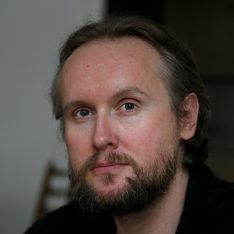
dr Jan Lorenz
Assistant Professor, Section of Theory and Methodology of Anthropology
Room: 2.46
Phone: 61 829 13 81
E-mail: jan.lorenz@amu.edu.pl
Office hours:
monday 14:00-15:00
tuesday 11:00-12:30
The first is the intersection of technology, religion, and ethics, particularly regarding robotics and artificial intelligence. I am especially interested in how these developments reshape our understanding of agency, subjectivity, and moral responsibility. My inquiries combine ethnographic fieldwork with critical engagement with religious doctrine and philosophy—both historical and contemporary. However, I place particular emphasis on the material, iconographic, and performative means by which metahuman and non-human presence and power are manifested, experienced and mobilized toward human transformation. This focus extends my research into experiemental religion as well as transhumanist and techno-eschatological movements. One case study in this line of inquiry centers on Android Kannon, a robotic bodhisattva housed in a Rinzai Zen temple in Kyoto. I examine this figure as a multivalent Buddhist artifact—one that challenges prevailing assumptions about how robots are implemented as moral and religious agents.
My second area of research investigates the means and forms of human transformation and self-formation, explored primarily through the lens of religious conversion and revivalism. This includes transformation enacted through ritual, orthopraxy, and religious learning, as well as profound shifts in kinship and ethnicity. In my work on conversion to Judaism in Poland, I examine how prospective converts seek spiritual transformation, reconstruct personal and familial relationships, and navigate religious laws, doctrinal demands, and their own place within Polish history and contemporary society.
Third, I engage with sensory media as a tool for research, communication, and public engagement. I have produced and co-authored ethnographic films and multimedia installations. Beyond utilizing video, sound recording, and photography in my fieldwork, I write about sensory evocation in media art, particularly as it relates to perceptual disability. My most recent theoretical contribution to this area is a publication on the role of film theory in ethnographic filmmaking. .
I am particularly interested in supervising theses and student research projects on the following topics:- Religion, ethics, and technology (especially artificial intelligence and robots)
- Subjectivity and self-formation
- The senses and materiality
- Art and visual anthropology
Publications
Lorenz, J. (2026) Consequential relatives: religious transformation and kinship in Polish conversions to Judaism. Journal of the Royal Anthropological Institute 32(1): 94-110.
Lorenz, J. (2025) Film Theory and Ethnographic Filmmaking. In: P. Vannini (ed.) The Routledge International Handbook of Ethnographic Film and Video (pp. 52-61). Abingdon, Oxon: Routledge.
Goldstein, P., & Lorenz, J. (2025). Active (Citizen) – Can Anyone Be an Activist? In: M. Le Calvé, P. Beck, & R. Stock (eds.), Drift. Sink. Emerge. Repeat. Diffracting the Critical through Multimodal Submersion: A Catalogue to the STS HUB 2025 Exhibition. https://doi.org/10.21428/b49345f3.8775d7ad
Lorenz, J. (2025). Metafizyczna obecność i pustka mechanicznego ciała. Android Kannon w świątyni rinzai zen. The Religious Studies Review, 295 (1), 77-96.
Lorenz, J. (2023). Kenkyū happyō. Kyūdai Tamaya Shōbei Kōenkai no Kaihō, 17, 2-3.
Lorenz, J. (2021). Tactics of Transformation: Self-formation and the Multiplicity of Authority in Polish Conversions to Judaism. In: M. Clarke, E. Morgan (eds.) Rules and Ethics: Global perspectives from anthropology and history (pp. 169-189). Manchester: Manchester University Press.
Lorenz, J. (2021). „The sound exists only in your own body”. Sensory approximation of visual and aural impairment in media art projects. Visual Anthropology, 34 (1), 35-53.
Lorenz, J. (2021). Being and Becoming. Polish Conversions to Judaism and the Dynamics of Affiliation. In: F. Guesnet, A. Polonsky, A. Rapoport-Albert & M. Wodziński (eds.) Polin: Studies in Polish Jewry Vol. 33: Jewish Religious Life in Poland since 1750 (pp. 425-437), Liverpool: Liverpool University Press.
Lorenz, J. (2018). Belief. In: J. Jackson (ed.) Oxford Bibliographies in Anthropology. New York: Oxford University Press. DOI: 10.1093/OBO/9780199766567-0190
Lorenz, J. (2016). Polish newcomers to Jewishness: A reflection in the wake of the revival. In: N. Fisher, T. Parfitt (eds.) Becoming Jewish: New Jews and Emerging Jewish Communities in a Globalized World (pp. 167-184). Newcastle upon Tyne: Cambridge Scholars Publishing.
Lorenz, J. (2016). Shades of closeness. Ontologies of belonging and becoming in a contemporary Jewish Community in Poland. In: M. Diemling, L. Ray (eds.) Boundaries, Identity and Belonging in Modern Judaism (pp. 63–75). Abingdon, Oxon: Routledge.
Lorenz, J. (2015). Counting as one. Moral encounters and criteria of affinity in Polish Jewish congregation. HAU: Journal of Ethnographic Theory 5(2), 51-81.
Lorenz J. (2011). Życie w miejscu śmierci. Muzeum/Obóz Stutthof w świetle doświadczenia I percepcji jego współczesnych mieszkańców. In Sztutowo czy Stutthof. In: Ł. Banaszek, M. Wosińska (eds.) Oswajanie krajobrazu kulturowego (pp. 173–187). Sztutowo: Muzeum Stutthof w Sztutowie.
Lorenz, J. (2007). Blizny od gwoździ. Haitański zombie jako idiom kulturowy i metafora traumy. Kultura i Społeczeństwo 51(4), 101–117.
Ethnographic films
Lorenz, J. (2023). Typhoon season. Adam Mickiewicz University.
Goldstein, P. & Lorenz, J. (2019). Active (citizen). Zentrum für Osteuropa- und internationale Studien.
- Award: Best Short Documentary, Capital Filmmakers Festival Berlin 2021
- Award: Best Environmental Film, Jahorina Film Festival 2021
- Award: Special Prize, Green Montenegro International Film Festival 2021
Lorenz, J. (2014). Passage. Granada Centre for Visual Anthropology, University of Manchester.
Lorenz, J. (2009). Star. Granada Centre for Visual Anthropology, University of Manchester.
Audiovisual instalations
Goldstein P., Lorenz J. (2022). Active (citizen) – Can anyone be an activist? Multiscreen installation. Zentrum für Osteuropa- und internationale Studien.
Permanent exhibition: Zentrum für Osteuropa- und internationale Studien, Berlin.
Temporary exhibition: STS Hub 2025 Berlin “Diffracting the Critical through Multimodal Submersions” (11-14.03.2025)
2022 Robots and automatons in Buddhist and Shintoist religious practice in contemporary Japan, research project, Adam Mickiewicz University. 1.09.2022 – 31.03.2023
2017, A co-investigator in the “Visualising the Invisible: Using visual ethnography to explore extra-institutional activism of migrants and ethnic minorities” visual anthropology project funded by British Academy/Leverhulme (with Dr Piotr Goldstein (PI), University of Manchester)
2014, Becoming Oneself, Becoming Another: Conversion to Judaism in contemporary Poland. Postdoctoral Fellowship, Centre for Jewish Studies, University of Manchester
2013, Informal Jewish education in Poland and creative practice with visual media, Centre for East European Language–Based Area Studies Research Internship (participatory video project and film workshop)
2008, “Relentless dybbuk. The loss, the memory and the revival of Jewish life in post-socialist Poland” Doctoral Fellowship